

Welding rigs, also commonly referred to as welding trucks, serve a variety of purposes.
They are used to transport equipment and tools to the job site, store supplies, and, most importantly, house the welder itself.
A welder’s rig is configured specifically for their needs and can be customized with a variety of features.
In this blog post, we will discuss what exactly a welding rig truck is. What is it used for? How to set it up, along with its advantages and disadvantages.
Let’s take a closer look.
What is a Welding Rig Truck?
A welding rig truck is a mobile unit designed to perform welding tasks directly on-site.
These large trucks are equipped to transport welding equipment, allowing welders to carry out repairs, installations, or fabrication work wherever it’s needed.
Think of a welding rig truck as a welder’s dream on wheels—a mobile workshop that brings the heat (literally) wherever it’s needed.
These aren’t just any trucks; they’re beefed-up, powerhouse vehicles built to carry all the heavy-duty welding gear you could imagine—torches, generators, welding machines, and sometimes even cutting tools—all neatly organized for quick on-site action.
Most welding rig trucks are customized beasts. From reinforced suspension to handle the extra weight, to specialized storage compartments for safety and efficiency, no two rigs are exactly alike.
The go-to favorite among pros is often the Peterbilt, but you’ll also find skilled welders cruising in Kenworths, Freightliners, or Macks, each rig bringing its own perks—like more engine power, better fuel efficiency, or extra workspace on the deck.
Driving one of these rigs isn’t for the faint of heart. Maneuvering a 30,000-pound mobile workshop through city streets or down an open highway takes skill, patience, and a touch of nerves of steel—much like the welds these trucks help produce.
How to Set Up a Welding Rig Truck?
Setting up a welding rig truck isn’t just hopping in and hitting the road—it’s like building a mobile powerhouse, step by step.
Here’s how to get it right without losing your mind (or your wallet).
1. Pick the Right Rig
Not all trucks are built the same. Your choice depends on the type of welding you do, the gear you need to haul, and your preferred ride—Peterbilt, Kenworth, or another heavy-duty beast. Think of it as choosing the right toolbox… on wheels.
2. Outfit Your Truck
Next, load it up. You’ll need a solid welder, a generator, storage for rods and tools, and safety gear. A few extras you didn’t think of will become lifesavers once you hit the first job site.
3. Budget Wisely
Before going all-in, calculate your setup cost. Include the truck, equipment, any custom modifications, and supplies. A little planning now saves a lot of headaches later.
4. Keep It Running
A rig this size needs regular TLC. Check oil, tires, brakes, and key systems. Neglect maintenance, and you’ll regret it faster than a bad weld.
5. Learn the Ropes
Operating a welding rig takes skill. Take the time to get trained on both driving and equipment. Knowing your rig inside out not only keeps you safe but also makes you look like a pro.
6. Handle the Legal Stuff
Register your business, get the permits, and make sure you’re operating within local regulations. Staying legit keeps the authorities off your back and your business running smoothly.
7. Build Your Reputation
Finally, your rig is only as good as the person behind it. Show up on time, deliver quality work, and soon clients will call you first. A solid reputation is your real engine.
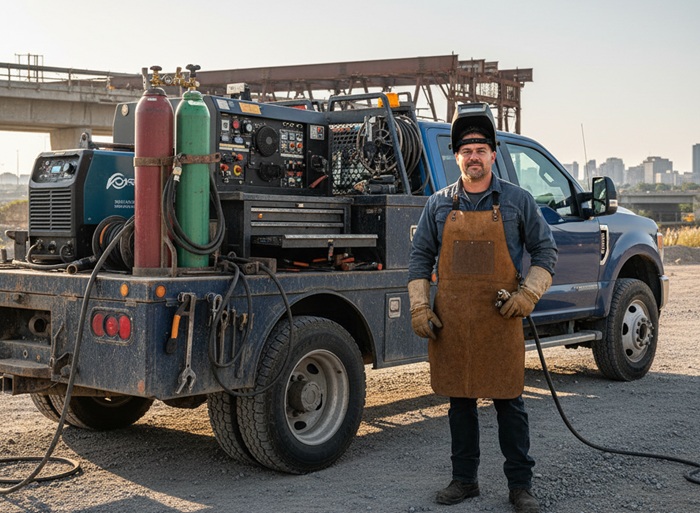
Features of Mobile Welding Rigs and Trailers
Mobile welding rigs aren’t just trucks—they’re rolling workshops built to make a welder’s life easier.
Features vary depending on the model and custom setup, but most rigs share some essential elements:
1. The Welder
This is the heart of the rig. Without it, you’ve just got a fancy truck. Whether it’s MIG, TIG, or stick welding, the machine does the heavy lifting of joining metal pieces together.
2. Generator
Need to weld in the middle of nowhere? A generator is an essential component that keeps the sparks flying when there’s no outlet in sight. It’s the lifeline for remote jobs and makes the rig truly self-sufficient.
3. Storage Space
A good rig comes with built-in compartments for rods, tools, and safety gear. Everything you need is right there, no more hunting for supplies mid-job.
4. Transportation Power
Of course, a rig’s main job is to haul everything to the site safely and efficiently. These trucks are designed to carry heavy loads while keeping equipment organized and secure.
Depending on size, features, and customization, a welding rig can cost anywhere from $30,000 to $100,000. It’s an investment—but one that turns a regular welder into a mobile pro.
Pro Tip: Don’t confuse a welding rig with a MIG welder. A MIG welder is just the machine that joins metals, while a welding rig is your whole mobile workspace, ready to tackle jobs wherever you go.

What are the Benefits of Using a Welding Rig Truck?
There are many benefits of using a welding rig truck. Some of the benefits of using a welding rig truck include:
They provide a mobile workspace: These welding rig trucks are designed to make the welder’s job easier by providing a mobile workspace.
These can be taken to any job site, which is very convenient for welders who often have to travel to different locations.
They are durable: Welding rig trucks are built to last. They can withstand the harsh conditions of the job and the wear and tear of everyday use.
They are powerful: These trucks are very powerful and can transport a lot of equipment.
This is helpful for welders who need to transport their supplies to the job site.
What are the Drawbacks of Using a Welding Rig Truck?
There are some drawbacks to using a welding rig truck. These include:
They can be expensive: Welding rigs can be very expensive. This is often a barrier for welders who are just starting out.
They often require special training: Welding rig trucks can be difficult to maneuver. So, rig truck drivers must be skilled in driving these large vehicles.
Most states do not require a license to drive a welding rig truck. However, you may need to obtain a commercial driver’s license (CDL) if you plan on driving the truck across state lines.
There is no specific route to becoming a rig welder. However, most welders start out by completing an apprenticeship or training program.
Once you have the necessary skills, you can then apply for a job with a welding company.
Rig welders can make anywhere from $30,000 to $100,000 per year. The exact salary will depend on experience and location.
Best Pickup Trucks for Welding Rigs (Considerations When Buying)
If you’re hunting for a welding rig for sale, you know it’s not just about the welder—it’s about the truck that hauls your whole mobile workshop.
The best pickup trucks for welding rig duty aren’t your everyday pickups.
We’re talking about heavy-duty machines built to carry tons of gear, withstand rough job sites, and still look good doing it.
Think Ram 3500, Ford F-350, or Chevrolet Silverado 3500HD—the kind of trucks that make other vehicles feel underpowered in comparison.
A Ram 3500, especially the dual-rear-wheel setup, is like the tank of mobile welding—it can carry your welder, generator, gas cylinders, and a small armory of tools without breaking a sweat.
Ford Super Duty F-350s are the favorite of welders who want a mix of muscle and tech, offering top-notch towing and payload capacities.
And don’t sleep on the Silverado or GMC Sierra 3500HD—they pack premium comfort and enough bed space for all your gear, making long drives to remote sites a little less painful.
Of course, for smaller rigs or lighter setups, trucks like the Ram 2500 offer a sweet balance between maneuverability and payload.
It’s perfect if you want something that handles city streets as well as dirt roads without feeling like you’re driving a cargo ship.
The right truck lets you focus on welding, not on whether your rig will bounce around like a trailer full of fireworks.
When you’re checking out a welding rig for sale, consider not just the truck, but how you’ll outfit it.
Flatbeds, lockable toolboxes, cranes or hoists, and a beefy electrical system to run your equipment can turn a solid truck into a fully functional mobile workshop.
The devil’s in the details, and a well-planned rig is the difference between smooth jobs and a headache every time you hit the road.
At the end of the day, the best pickup trucks for welding rig work are the ones that let you carry your tools, handle the terrain, and arrive at the job looking like a pro.
After all, when your rig shows up, it should make people say, “Now that’s a welder who means business.”