

A truck battery is more than just the part that gets your engine started—it’s the backbone of your vehicle’s entire electrical system.
From ignition to lighting, HVAC, and onboard electronics, everything depends on having the right power source. But not all batteries are created equal.
Understanding the different types—whether lead-acid, AGM, gel, or lithium—helps you match the right battery to your truck’s workload and climate.
In this guide, we’ll cover the most common truck batteries, their technical strengths, and where each type performs best on the road.
Different Types of Truck Battery
Truck batteries differ in chemistry, construction, and performance ratings, which affect how they handle high cranking demands, deep cycling, and harsh operating conditions.
For example, some are designed to deliver short bursts of high cold-cranking amps (CCA) for reliable starts in freezing weather, while others are built to provide steady energy for running accessories or auxiliary equipment.
Some of the most common types of truck and car batteries include:
1. Standard Flooded Lead-Acid (FLA)
The standard battery design is the most popular and widely used design. It’s also the most affordable option.
The standard battery design uses lead plates that are submerged in an electrolyte solution. This design is best suited for trucks that are used infrequently.
2. Starting (Cranking) Batteries
Starting batteries are designed to provide a large amount of power for a short period of time.
This is the type of battery that is used to start the engine and they typically have a capacity of around 60-85 Ah.
So, if you are looking for a battery that can provide a lot of power for just starting your truck, then this is the type of battery you need.
3. Dual-Purpose Batteries
Dual-purpose batteries are designed to provide both starting power and deep cycling power.
This type of battery is often used in trucks that have accessories that require a lot of power, such as winches or air compressors.
Dual-purpose batteries typically have a capacity of around 100-120 Ah.
4. Deep Cycle Batteries
Deep cycle batteries are designed for long, slow discharge cycles.
This type of battery is often used in trucks that frequently idle for long periods of time, such as delivery trucks.
Deep cycle batteries have a capacity of around 200-400 Ah and are great for trucks that have a lot of accessories that require power.
5. Lithium-ion Batteries
Lithium-ion batteries are a newer type of battery that is becoming more popular in trucks.
These batteries have a much higher energy density compared to other battery types, meaning that they have the ability to store more energy in a small space.
These batteries also have a longer lifespan than other types, and they are not as affected by temperature changes.
6. AGM Batteries
The absorbed glass mat battery design is a newer design that’s becoming more popular.
AGM batteries are a type of lead-acid battery that uses absorbed glass mat technology.
The design basically uses lead plates that are covered in an absorbent glass mat. The electrolyte solution is absorbed into the mat, which reduces the chance of spillage.
This design is best suited for trucks that are used frequently or for applications where deep discharge cycles are required.
These batteries for trucks are more resistant to vibration and shock than other types of lead-acid batteries, making them ideal for use in trucks.
AGM batteries typically have a capacity of around 100-200 Ah.
7. Gel Batteries
Gel batteries are a type of lead-acid battery that uses a gel electrolyte instead of a liquid electrolyte.
These batteries are usually maintenance-free and have a longer life than traditional lead-acid batteries.
They are often used in applications where deep discharge cycles are required, such as golf carts, RVs, and UPS systems.
Gel batteries are also more resistant to vibration and shock, making them ideal for use in marine and other harsh environments.
8. Dry Cell Batteries
A dry cell battery is a lead-acid battery that uses a non-spillable electrolyte.
The electrolyte is a mix of sulfuric acid and calcium sulfate that is absorbed into the separator between the positive and negative plates.
They can be used in hot or cold weather and are not susceptible to freezing.
However, they are more expensive than flooded cell batteries and require more frequent replacement.
9. Maintenance-Free Batteries
Maintenance-free batteries for trucks are specially designed to eliminate the need for regular watering.
This means that you won’t have to constantly check the level of the electrolyte solution and top it up when necessary.
Instead, the batteries are sealed, and the electrolyte is absorbed into a glass mat that’s located between the positive and negative plates.
What is a Valve-Regulated Lead-Acid (VRLA) Battery?
A valve-regulated lead-acid (VRLA) battery is a sealed, maintenance-free alternative to traditional flooded designs.
It uses absorbed glass mat (AGM) or gel electrolyte to keep the acid in place, making it spill-proof, vibration-resistant, and safer. A built-in pressure relief valve vents excess gas during charging, eliminating the need for regular watering.
VRLA batteries are widely used in trucks, solar systems, backup power, and electric vehicles. They offer longer life, low upkeep, and solid reliability, which is why many truck owners prefer them despite a slightly higher upfront cost.
| Battery Type | Best For | Limitation | Cost Level |
|---|---|---|---|
| Standard Flooded Lead-Acid (FLA) | Basic starting needs, light or occasional truck use | Requires maintenance, prone to spillage, shorter lifespan | 💰 (Most budget-friendly) |
| Starting (Cranking) Batteries | Quick engine ignition, reliable starts in cold weather | Poor at deep discharge, limited accessory support | 💰 |
| Dual-Purpose Batteries | Trucks with moderate accessory load (winches, lights, compressors) | Compromise between starting and deep-cycle performance | 💰💰 |
| Deep Cycle Batteries | Long idle times, delivery fleets, heavy accessory use (inverters, fridges) | Weaker at fast cranking | 💰💰 |
| Absorbed Glass Mat (AGM) | Daily use, off-road, vibration-heavy conditions | Higher cost than flooded, heavier than lithium | 💰💰💰 |
| Gel Batteries | Deep discharges in RVs, marine or specialty trucks | Sensitive to charging errors, poor cold-weather performance | 💰💰💰 |
| Dry Cell Batteries | Extreme hot/cold climates, spill-proof use | Pricier, shorter replacement cycle than AGM/lithium | 💰💰💰 |
| Maintenance-Free Batteries | Owners wanting zero upkeep | Cannot be serviced once worn out | 💰💰💰 |
| Lithium-Ion Batteries | Premium trucks, high performance, fleets needing long lifespan | Expensive upfront, requires compatible charging system | 💰💰💰💰 (Most premium) |
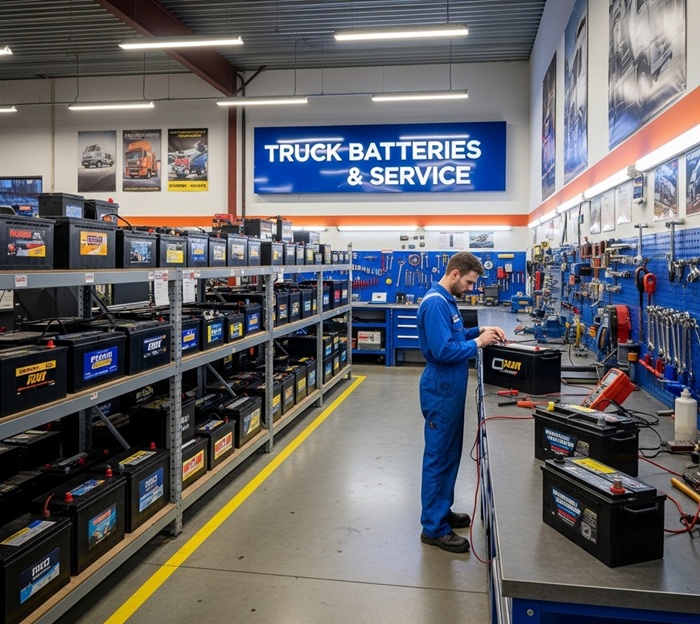
How to Choose the Right Battery For Your Truck?
When I had to replace my first truck battery years ago, I thought it was as simple as grabbing the cheapest option that fit under the hood.
I quickly learned the hard way that not all batteries are built the same—what worked fine for a small pickup wasn’t nearly enough when I upgraded to a heavy-duty truck with winches and extra lights.
Choosing the right battery can save you from headaches, breakdowns, and wasted money.
The starting point is always size and fitment.
Truck batteries are classified by group numbers that determine their physical size and terminal placement.
If you drive a pickup, you might get by with a smaller group size, but a semi-truck or construction vehicle often demands much larger or even multiple batteries to handle the load.
Never underestimate this step—getting the wrong size can leave you stranded with a battery that simply can’t deliver.
Then comes the battery type.
Flooded lead-acid batteries are the budget-friendly workhorses, but if you use your truck daily, deal with rough roads, or need deep-cycle capacity for accessories, an AGM or dual-purpose battery is usually worth the extra investment.
And if you’re the kind of person who values long-term reliability over short-term savings, lithium-ion is the gold standard—it’s lighter, lasts longer, and shrugs off extreme temperatures.
Finally, think about how you really use your truck.
If it only comes out for weekend drives, you probably don’t need a premium battery.
But if your truck is your livelihood—hauling, towing, idling for hours, or powering accessories—a stronger, higher-capacity option will pay for itself many times over.
A well-matched battery means fewer jump-starts, smoother starts in the cold, and peace of mind knowing your rig won’t fail when you need it most.
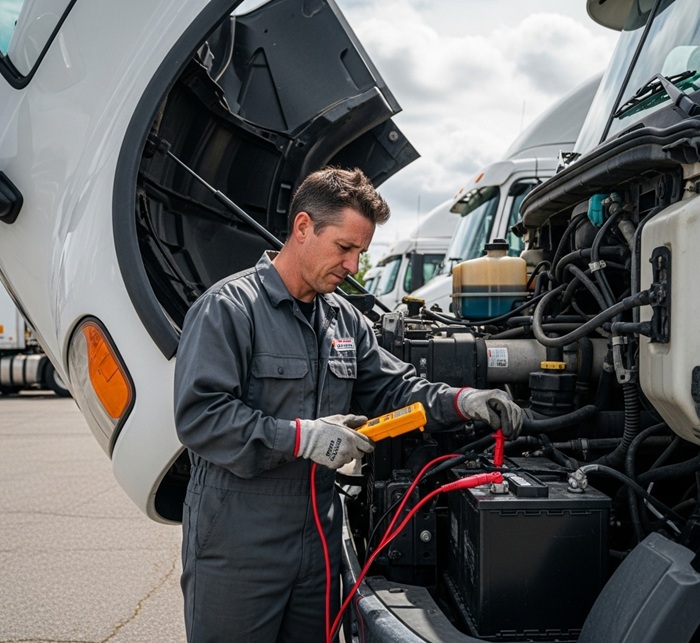
Is Lithium-ion Battery For Hybrid or Electric Vehicles Good to Use?
If you’ve ever wondered what really makes hybrids and electric vehicles tick, the answer almost always comes down to the battery—and lithium-ion is the clear winner here.
I still remember the first time I drove an EV; what impressed me wasn’t just the quiet ride, but how effortlessly the power kicked in.
That instant torque and smooth acceleration are only possible because of lithium-ion technology.
These batteries pack more punch in a smaller package. Their high energy density means you get more miles out of a single charge, and their high power density ensures strong performance every time you hit the accelerator.
Unlike older battery types, lithium-ion is lighter, charges faster, and lasts longer—features that make hybrids and EVs not just possible, but practical.
On a technical level, the magic happens inside each cell. A lithium cobalt oxide cathode and a carbon anode are separated by a thin layer that lets ions move but blocks electrons.
When charging, ions flow to the anode and store energy; when discharging, they move back and release power through the external circuit. It sounds complex, but what it really means for you is reliable energy that responds the instant you need it.
Now, yes—lithium-ion batteries do cost more upfront. But think of it as an investment.
You’re paying for longer range, quicker charging, a lighter setup, and years of dependable performance. That’s why nearly every modern hybrid and EV, from small city cars to heavy-duty electric trucks, is powered by lithium-ion.
So, if you’re considering a hybrid or electric vehicle, don’t think of lithium-ion as just “good enough.”
It’s the technology that makes the entire experience possible—and once you’ve driven with it, you’ll understand why it’s become the gold standard.
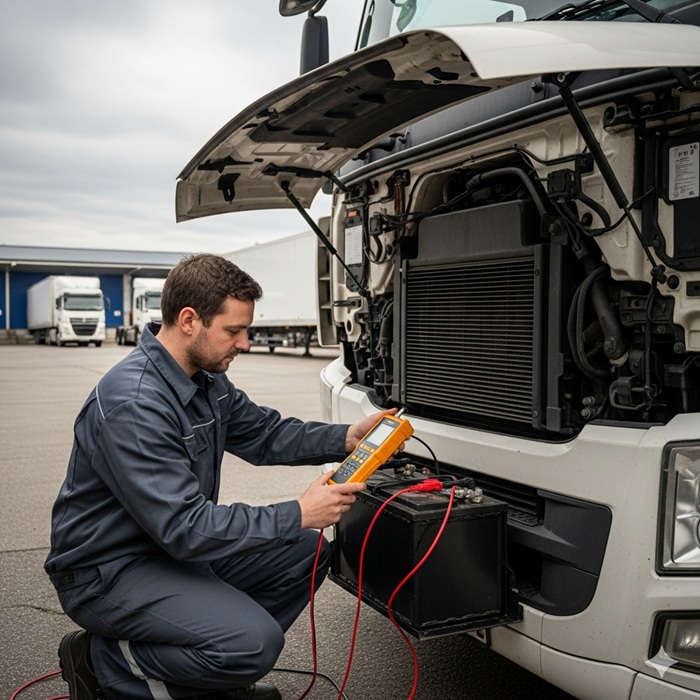
Flooded Battery or Wet Cell Battery – What to Choose for Your Truck?
The flooded battery—also called a wet cell battery—is probably the first type of battery I came across when I started dealing with trucks.
It’s the old-school design that uses an electrolyte mix of water and sulfuric acid inside its cells to store and release energy. Even today, this is still one of the most widely used batteries in trucks and heavy vehicles.
What I like about flooded batteries is how serviceable they are. If the electrolyte runs low, I can just top it up with distilled water and keep going.
For someone who spends a lot of time on the road, that kind of fix-it-yourself ability feels reassuring. Plus, they’re usually cheaper than sealed batteries, which makes them a budget-friendly choice if you don’t want to overspend.
But I’ll be honest—there are some headaches too. Flooded batteries need regular maintenance, and you have to keep them upright to avoid spills.
I’ve also noticed they don’t handle extreme temperatures very well—freezing up in bitter cold or struggling in hot summers. For trucks that face rough conditions, that can be frustrating.
So, if you’re the kind of owner who doesn’t mind checking water levels now and then, a flooded battery might still be the right fit.
Personally, I like the reliability they offer for the price. But if you’d rather skip the maintenance and get better performance in tough climates, I’d lean toward AGM or even lithium options.
At the end of the day, it’s about balancing cost, convenience, and how much effort you want to put into looking after your truck’s battery.
Who Makes the Best Battery for Trucking? – And How Much Does It Cost?
When it comes to truck batteries, there isn’t really a single “best” brand—it often comes down to matching the right battery with the way you use your truck.
Some of the most trusted names in the industry include Duracell, Energizer, Interstate Batteries, Optima, and Trojan.
Over the years, I’ve seen truckers swear by different brands depending on whether they prioritize long cranking power, vibration resistance, or deep-cycle performance.
If you ask me, the smart move is not just to go by the brand name, but to check real-world reviews from other truck owners who drive in conditions similar to yours.
A battery that works perfectly for someone hauling long distances in mild climates may not perform the same for heavy-duty use in extreme heat or cold.
As for cost, truck batteries aren’t one-size-fits-all. The price depends on the battery type (flooded, AGM, or lithium), size, and your truck model.
On average, you’re looking at anywhere between $100 and $300 for most standard truck batteries. Premium AGM or lithium options can cost more, but they often pay off with longer life and better performance under stress.
I always recommend shopping around—both online and at local auto parts stores—to compare prices and warranty coverage.
Sometimes, the extra money you spend on a better warranty or a brand with strong roadside support can save you big headaches later.
The conclusion
There are a number of different batteries that can be used in a truck. It is important to choose one that is right for your truck type and design.
Some of the factors that you should consider when choosing a battery for your semi-truck include the size of your truck, the type of engine that you have, the climate in which you live, and your driving habits.
When you keep these things in mind, you can easily narrow down your choices and choose the best battery for your truck.